Table of Contents
- Introduction
- What Is an AI-First Organization?
- Why AI Is Reshaping the Workplace
- New Roles Emerging in AI-Driven Companies
- Human + Machine: The Perfect Partnership
- Skills You’ll Need to Stay Ahead
- Challenges in Adapting to AI-First Workplaces
- The Road Ahead: Are You Ready for the AI Shift?
- Conclusion and Call to Action
Introduction
If you walk into work one morning (or, more likely, log in from your kitchen table), and your AI assistant has already prioritized your tasks, drafted your morning emails, and predicted which client needs extra attention today.
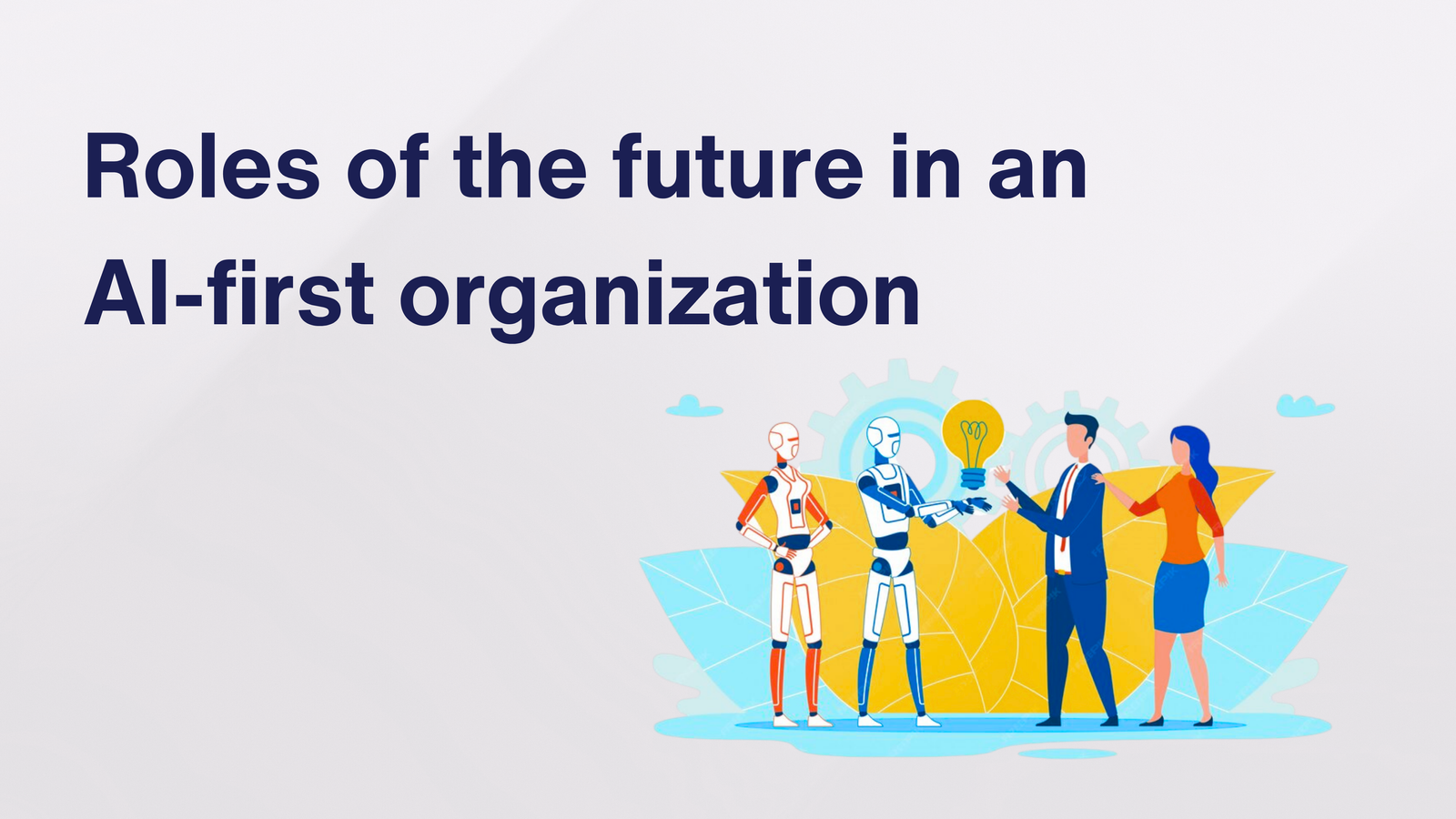
Sounds convenient, right? Welcome to the AI-first organization, a workplace where artificial intelligence isn’t just a tool, but a team member.
But here’s the twist: as AI gets smarter, our roles don’t disappear. They evolve. And understanding how is what separates tomorrow’s leaders from yesterday’s job titles.
So, grab your coffee, let’s explore what the roles of the future in an AI-first organization will really look like.
What Is an AI-First Organization?
Let’s keep it simple. An AI-first organization is one that uses artificial intelligence not as an add-on, but as the backbone of its decision-making, operations, and strategy.
Think of it like a company where every department, from HR to marketing to logistics, has an invisible assistant constantly learning, predicting, and improving.
It’s not science fiction anymore. We’re living in an era where AI drafts reports, analyzes customer sentiment, and even helps CEOs make smarter, data-backed decisions.
But here’s the kicker: the magic still needs people to direct it. AI is powerful, but without human creativity, context, and ethics, it’s just a well-trained parrot with no sense of direction.
Why AI Is Reshaping the Workplace
AI is changing how work gets done, but more importantly, it’s changing what work actually means.
Just think about it, we’ve gone from typing data into spreadsheets to teaching algorithms how to type for us. The shift isn’t just technical; it’s philosophical.
AI-first companies are moving from task-driven roles to outcome-driven ones. Instead of asking “What should I do today?”, employees are asking “How can AI help me do this better?”
That simple mindset shift is what’s driving entire industries forward.
New Roles Emerging in AI-Driven Companies
Now we get to the fun part, the roles of the future. Some of these sound straight out of a sci-fi movie, but they’re already starting to appear.
Here are a few that caught my eye (and imagination):
- AI Ethicist – The conscience of the company. This person ensures that the organization’s AI decisions are fair, unbiased, and transparent. Basically, the voice that asks, “Should we?” not just “Can we?”
- Prompt Engineer – Think of this as the AI whisperer. They craft the perfect prompts that get the most effective and creative responses from generative AI tools.
- AI Business Translator – A bridge between tech and strategy. They make AI outputs meaningful for executives who prefer numbers on slides over lines of code.
- Machine Collaboration Specialist – Their job? To make sure humans and machines work together smoothly, no turf wars between bots and people.
- Data Curator – Like a librarian, but for data. They ensure the information feeding AI models is clean, ethical, and relevant.
Pretty exciting, right? But it doesn’t stop there. In the AI-first organization, every job, from marketing to HR, will have an “AI” flavor to it.
Imagine a salesperson using predictive analytics to know which clients are ready to close, or a teacher using AI to personalize lessons for each student. The possibilities are endless.
Human + Machine: The Perfect Partnership
Here’s a truth bomb: AI won’t replace you. But someone who knows how to work with AI just might.
That’s the secret sauce of the AI-first era, collaboration. Machines are incredible at processing data, but humans are unmatched in empathy, judgment, and storytelling.
I like to think of it as a duet: AI plays the instruments, but humans write the lyrics. Without one, the song falls flat.
So, rather than seeing AI as competition, it’s time to see it as your co-worker, one who never takes lunch breaks but still needs direction.
Skills You’ll Need to Stay Ahead
So, what do you need to thrive in this AI-first landscape? Don’t worry, it’s not all coding and math.
Here’s what matters most:
- Curiosity – The courage to ask, “What if?” and experiment with AI tools instead of fearing them.
- Critical Thinking – The ability to question AI’s outputs and separate fact from flaw.
- Communication – Translating data-driven insights into stories that inspire real action.
- Ethical Awareness – Understanding how AI decisions affect people and communities.
- Adaptability – Staying nimble as technology evolves faster than your phone updates.
These skills are what will make you indispensable, no matter how intelligent the algorithms become.
Challenges in Adapting to AI-First Workplaces
Of course, every revolution has its bumps.
One of the biggest challenges is trust, both in AI and in ourselves. Can we trust machines to make fair decisions? Can we trust ourselves to use them wisely?
Then there’s the fear factor, the idea that AI might replace jobs. But in truth, AI replaces tasks, not people. The real danger is in refusing to evolve.
As one wise manager told me, “AI won’t take your job. But someone who understands AI probably will.”
That stuck with me.
The Road Ahead: Are You Ready for the AI Shift?
We’re stepping into an era where understanding AI will be as important as knowing how to send an email.
Companies that adapt early, train their teams, invest in AI literacy, and create hybrid human-machine workflows, will be the ones leading the next decade of innovation.
And those who wait? They’ll be watching from the sidelines, wondering where the time went.
So the question is: are you preparing to lead in an AI-first organization, or waiting to catch up?
Conclusion
The roles of the future aren’t about replacing people, they’re about redefining what people can do.
In an AI-first organization, your creativity, empathy, and ethics are your superpowers. Machines might run the numbers, but only humans can make meaning out of them.
So here’s my call to action: start learning how to collaborate with AI today.
Experiment with tools. Ask questions. Get curious. Because the future isn’t waiting for permission, it’s already here.
And who knows? The next big innovation might not come from a tech lab in Silicon Valley… it might come from you.
Leave a Reply